
Common Physical Therapy terms, explained.
A quick reference for the treatment techniques, modalities, and exercise terms you may hear during your care. If you ever hear a term during your visit that isn't listed here, just ask, we're always happy to explain.
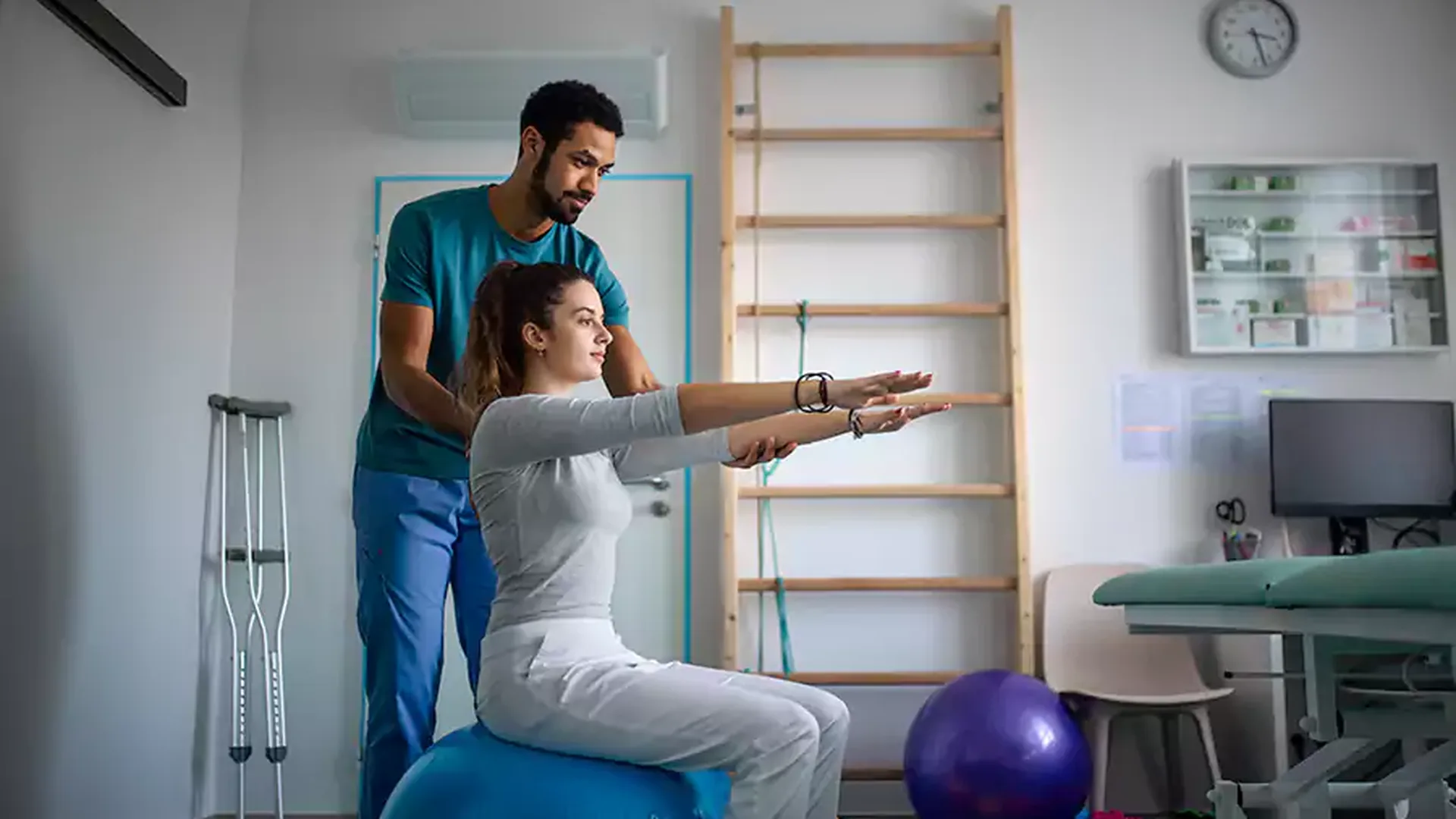
(Pictured only for the shoulder) Therapist-assisted active range motion. This treatment is often used to strengthen or gentle stretch a weak area of the body.
Stationary cycling is often prescribed to improve strength and/or range motion of the hips or knees, as well as cardio-vascular endurance.
A range of motion against gravity that allows the patient to move the ankle. AROM is often prescribed for arthritis, first recovery of joint motion, and/or gentle strengthening of joints.
These are hands-on therapies that increase ankle and soft tissue mobility. Mobilization is used to improve mobility, reduce joint stiffness, and relieve pain. There are many mobilization methods available, including Grimsby and Maitland, Kaltenborn, Isometric Mobility, etc.
The patient’s or the therapist’s movement of the ankle through a range without using the muscles that “actively” move those joint(s).
You should gradually increase your resistance (weights) as well as the repetitions. PRE is often prescribed to strengthen and retrain muscles. As resistance, weights, rubber bands and your body weight are all possible.
The core is made up of the trunk and the associated muscles. The extremities include the forearms and hands, hands, thighs, legs and ankles/feet. Strong core muscles are essential for extremities to be able to attach to each other and perform more efficiently. The theory is that a weak core can put excessive strain on the extremity muscles and tendons, ligaments, and joints. Core strengthening involves multi-joint exercises that involve larger muscle groups, such as the abdominals, chest, back, hip/thigh and shoulder blade muscles. Core strengthening is often integrated into a neck or low back rehabilitation program. Core strengthening is often part of a program for arm, leg, ankle, or forearm rehabilitation. It provides stability for the extremities and recovery or enhancement of core power
Cold therapy is used to induce vasoconstriction, which causes blood vessels to constrict or decrease in diameter. This reduces the fluid that leaks from the capillaries into tissue spaces. A cold or ice is most commonly used for acute injuries. However, it can also be used to relieve chronic pain. A cold therapy can be used by applying a cold pack to the area or by giving ice massages as shown in the video.
A range of motion against gravity that allows the patient to move the elbow. AROM is often prescribed for arthritis, first recovery of joint motion, and/or gentle strengthening of the joints.
These are hands-on therapies that increase elbow and soft tissue mobility. Mobilization is used to improve mobility, reduce joint stiffness, and relieve pain. There are many mobilization methods available, including Grimsby and Maitland, Kaltenborn, Isometric Mobility, and others.
The patient’s or the therapist’s movement of the elbow through a range without using the muscles that “actively” move those joint(s).
You should gradually increase your resistance (weights) as well as the repetitions. PRE is often prescribed to strengthen and retrain muscles. As resistance, weights, rubber bands and your body weight are all possible.
For self-joint mobilisation, postural exercise and core stability, exercises are typically done on a half cylinder or cylinder of foam.
Visually examining the interaction between the low back, the joints of the legs, thighs, and feet at various stages of walking can help to identify walking problems. This includes initial contact, loading response and mid stance, terminal and terminal stances, pre swing, swing, swing and terminal swing. Gait abnormalities can cause or manifest problems in the back, leg, ankle and foot.
A range of motion against gravity that allows the patient to move their hand. AROM is often prescribed for arthritis, first recovery of joint motion, and/or gentle strengthening of the joints.
To reduce chronic pain and relax muscles, heat is recommended. It shouldn’t be used for an “acute” or “new” injury.
Cold Therapy Heat Pack Ultrasound
A range of motion against gravity that allows the patient to move the hips. AROM is often prescribed for arthritis, first recovery of joint motion, and/or gentle strengthening of joints.
These are hands-on therapies that increase hip mobility and soft tissue. Mobilization is used to improve mobility, reduce joint stiffness, and relieve pain. There are many mobilization methods available, including Grimsby and Maitland, Kaltenborn and Isometric Mobilizations.
The patient’s or the therapist’s movement of the hip through a range without the use of muscles that “actively” move the joints.
You should gradually increase your resistance (weights) as well as the repetitions. PRE is often prescribed to strengthen and retrain muscles. As resistance, weights, rubber bands and your body weight are all possible.
To cause vasoconstriction, ice is applied directly to the skin to increase blood flow to the tissues.
An isometric exercise refers to a muscle contraction that does not involve joint movement. Isometrics can be used to gently re-educate the nerves and muscles. These are used to strengthen the muscles of patients with arthritis, post-surgical patients and as an introductory exercise in muscle strengthening. The progression from isometrics is to active and resistive joint movements.
Muscles contracting with resistance through the range of motion (ROM). This is often used to strengthen muscles.
AROM is the movement of the knee by the patient through a range against gravity. AROM is often prescribed for arthritis, first recovery of joint motion, and/or gentle strengthening of joints without trauma.
These are hands-on therapies that increase knee and soft tissue mobility. Mobilization is used to improve mobility, reduce joint stiffness, and relieve pain. There are many mobilization methods available, including Grimsby and Maitland, Kaltenborn, Isometric Mobility, and others.
The patient’s or the therapist’s movement of the knee through a range without the use of muscles that “actively” move any joint(s).
You should gradually increase your resistance (weights) as well as the repetitions. PRE is often prescribed to strengthen and retrain muscles. As resistance, weights, rubber bands and your body weight are all possible.
A range of motion against gravity that allows the patient to move the lower back. AROM is often prescribed for arthritis. It helps to restore joint motion and strengthen the joints without causing any trauma.
These are hands-on therapies that increase low back and soft tissue mobility. Mobilization is used to improve mobility, reduce joint stiffness, and relieve pain. There are many mobilization methods available, including Grimsby and Maitland, Kaltenborn, Isometric Mobility, etc.
Movement of the low back by the patient/therapist through a range motion without the use or “actively” moving the joint(s).
You should gradually increase your resistance (weights) as well as the repetitions. PRE is often prescribed to strengthen and retrain muscles. As resistance, weights, rubber bands and your body weight are all possible.
A longitudinal or axial pull on the lumbar spinal column, whether it is manual, mechanical, intermittent, or continuous. For muscle spasm and low back pain relief, pelvic traction might be an option.
Based on the patient’s symptoms, exercises are prescribed to “centralize” pain or move it out of the leg and thigh. These exercises are part a comprehensive program that includes extensive patient education in order to manage pain episodes, both current and future.
AROM is the movement of the middle back by the patient through a range against gravity. AROM is often prescribed for arthritis, first recovery of joint motion, and/or gentle strengthening of joints without trauma.
These are hands-on therapies that increase mobility of the soft tissues and middle back joints. Mobilization is used to improve mobility, reduce joint stiffness, and relieve pain. There are many mobilization methods, including Maitland and Kaltenborn, Isometric Mobilizations, and others.
AROM is often prescribed for arthritis, first recovery of joint motion, and/or gentle strengthening of the joints.
These are hands-on therapies that increase neck and soft tissue mobility. Mobilization is used to improve mobility, reduce joint stiffness, and relieve pain. There are many mobilization methods available, including Grimsby and Maitland, Kaltenborn, Isometric Mobility, and others.
Neck Passive Range Of Motion The passive movement of the neck by the patient/therapist through a range motion that does not require the use of muscles that “actively move” the joint(s).
You should gradually increase your resistance (weights) as well as the repetitions. PRE is often prescribed to strengthen and retrain muscles. As resistance, weights, rubber bands and your body weight are all possible
For relief of neck pain, a gentle longitudinal/axial pull on your neck, whether mechanical or manual, intermittently or continuously, to reduce muscle spasm and unload the spine.
Electrical stimulation is used to increase strength, such as the quadriceps muscles after a knee injury or surgery. Neuromuscular Electrical Stimulation is used to reduce pain and swelling, and to alleviate muscle spasm.
These exercises are characterized by rapid muscle stretching followed by muscle shortening. This allows muscles to develop maximum force. They are designed to increase reactive/explosive muscular performance.
Correct biomechanical alignment is important to minimize strain on muscles, joints and ligaments. Although there is an ideal position, most people don’t have it. Your therapist teaches you how to improve posture and body mechanics in daily activities. To improve postural alignment and prevent future disability or recurrences, strengthening and stretching exercises can be recommended.
Proprioception refers to the body’s ability detect where it is in space. Close your eyes and feel your nose. You can move your finger from your nose to your nostrils without even seeing them. After a musculoskeletal trauma, proprioception exercises can be used to help you retrain your senses. To sense how your joints and muscles move, your body relies on its sensory system. Your body’s proprioceptive abilities are crucial for balance and coordination.
Performs diagonal patterns to mimic functional movements. This technique was originally used for neurologically and developmentally impaired patients. PNF or a variant thereof is used today for nearly every aspect of neuromuscular rehabilitation. It can be used to treat a professional athlete or someone living in a nursing facility.
A range of motion against gravity that allows the patient to move the shoulder. AROM is often prescribed for arthritis, first recovery of joint motion, and/or gentle strengthening of joints without trauma.
These are hands-on therapies that increase shoulder and soft tissue mobility. Mobilization is used to improve mobility, reduce joint stiffness, and relieve pain. There are many mobilization methods available, including Grimsby and Maitland, Kaltenborn and Isometric Mobilizations.
The patient’s or the therapist’s movement of the shoulder through a range without using the muscles that “actively” move any joint(s).
You should gradually increase your resistance (weights) as well as the repetitions. PRE is often prescribed to strengthen and retrain muscles. As resistance, weights, rubber bands and your body weight are all possible.
Massage of the body with the hands. Soft tissue mobilization can be used to relax muscles, decrease swelling, decrease scar tissue adhesions and provide pain relief.
Aerobic Exercise – The American College of Sports Medicine defines aerobic exercise as: “Any activity that involves large muscle groups, can last for a long time, and is rhythmic in nature.” Aerobic is defined as exercise that takes place in the presence or absence of oxygen. Your body burns its fuel (glucose), in the presence oxygen. This is done at less than 85% your maximum heart rate. Aerobically fit individuals can work harder, longer and recover faster after each session. Aerobic exercise can be done in a variety of ways, including swimming, biking, rowing, aerobics classes and swimming.
Stretching exercises are designed to lengthen muscles or soft tissues. Stretching is often prescribed to increase flexibility in muscles that are tightened by injury, pain, spasm, or immobilization.
The electrical stimulation “disguises” pain and “overrides” it. It is a portable, small unit that can be used intermittently to reduce pain and dependence on drugs. It is often prescribed to relieve pain.
The patient can move the jaw against gravity by moving it through a variety of motions. It could include opening the mouth, moving the jaw sideways, or protrusion (moving your jaw forward).
A therapeutic ball is a rubber ball with a diameter of 55-85+ centimeters that can be used to strengthen, balance and exercise flexibility. Also known as a Swiss ball or therapy ball. The ball acts as a pivot point or fulcrum around which to perform exercises. To perform an exercise, the ball must be stable and concentrated.
Neuromuscular Electrical Stimulation Transcutaneous electrical nerve stimulation (TENS). Iontophoresis
A wrist movement by the patient through a range against gravity. AROM is often prescribed for arthritis, first recovery of joint motion, and/or gentle strengthening of the joints.
These are hands-on therapies that increase wrist and soft tissue mobility. Mobilization is used to improve mobility, reduce joint stiffness, and relieve pain. There are many mobilization methods available, including Grimsby and Maitland, Kaltenborn, Isometric Mobility, etc.
The patient’s or the therapist’s wrist movement through a range without using the muscles that “actively move” the joint(s).
The patient’s or the therapist’s wrist movement through a range without using the muscles that “actively move” the joint(s).
Schedule Your Appointment
No referral needed. Most insurances accepted. Same-week appointments available.
You’re all set.
We’ll reach out within one business day to confirm your appointment. If you need to speak with us sooner, call us directly.